What exactly is a detention basin and how do they work?

Simon Mumford
27 February 2026, 7:16 PM
February 28, 2026, isn't just the fourth anniversary of the big flood; it is also four months until the release of the $11.4 million Northern Rivers Resilience Initiative. This is when the CSIRO proves whether flood mitigation is possible for the Richmond River catchment.
We know that CSIRO lead scientist Jai Vaze is testing 2 bundles using three different floods, 2008, 2017 and 2022.
There are four constant flood measures in both bundles, they are the Tuckean Swamp upgrade (barrage operates optimally), the Tuckombil upgrade (replace Fabri-dam with a swing gate), Bruxner Highway upgrades (culverts) from Casino and the opening of Boundary Creek to the ocean north of Evans Head. The Boundary Creek calculations for the effective width have not been calculated yet.
The difference in the two bundles being modelled is the number of detention basins at choke points in the upper and lower areas of the Richmond River Catchment. Bundle 1 will model 5 detention basins, while Bundle 2 will model 9 detention basins.
What is a detention basin?
Basically, a detention basin is a man-made structure that holds water temporarily during a heavy rainfall period that may lead to flooding further downstream. The size of a detention basin is determined by its needs. In our case, the optimal size will be determined by the CSIRO modelling.
The wall of a detention basin can be nature-based or man-made, most likely concrete. In our case, this will most likely be concrete, due to the potential size needed to hold back a large volume of water and to allow remote operation of automatic release gates.
As the detention basins are temporary and not a permanent water storage facility, there will be natural flora growth.
Lead CSIRO Scientist Jai Vaze said, "All the water will be gone if they are used just for flood mitigation and detention. Then once the water is released, effectively, it will be back to the normal land, except that there will be that blockage, but the river will be open.
"In normal conditions, the water flows within the bank, only during floods does it exceed. And also, I will say that the areas we have picked where we will be detaining, were already fully flooded, meters of water under for a substantial time during 2022."
Jai clarified that he and his team do not provide any detailed structural design for the detention basin wall.
"That's not our expertise. What I will be showing here is, what are the potential options . After that, there are so many steps. So if the government of the day, state, federal and council are all on the same page and they want to implement it, then a business case will have to be put. A proper structural analysis has to be done. They might have to run a flexible mesh 2d model, which gives more options for stress testing."
Jai explained that 2D is used for modelling the floodplain (water over land), while 1D is used for rivers. "You need that because most of the water was on the land, and it came from the land to the river, but then it travels mostly through the river."
DETENTION BASINS IN ACTION
There are a number of detention basins in action around Australia. Finding information from relevant government departments, however, was difficult to ascertain. There was a lot of handballing, with no agency willing to give detailed answers to a lot of questions. That includes the Queensland Reconstruction Authority (QRA), which put us on to the Dam Safety Team in the Department of Local Government, Water and Volunteers. Detailed answers were to be sourced from local councils.
In NSW, we were directed to NSW Water, which directed us to Sydney Water or the relevant local council.
It appeared that no one wanted to go on record detailing the components and success of their detention basin.
On 1 December 2020, the QRA said on its website:
Images of the flash flooding through Toowoomba’s CBD became one of the iconic memories of the Queensland floods in January 2011.
In 2015, Toowoomba Regional Council completed $25 million worth of flood mitigation projects, ensuring the city is more resilient to future flooding events.
The West Creek component involved West Creek channel works to increase capacity between James Street and Herries Street as well as an upgrade to the Goggs Street stormwater system.
The East Creek component consisted of new detention basins at Ballin Drive Park and Garnet Lehman Park, an upgraded detention basin at Ramsay Street/Spring Street, upgraded culvert beneath South Street on East Creek, and East Creek channel works to increase capacity between James Street and Creek Street by upgrading the Mary Street culvert.
The flood mitigation projects were made possible by $20 million in joint State-Commonwealth NDRRA Category D funding and $5 million contribution from Toowoomba Regional Council.
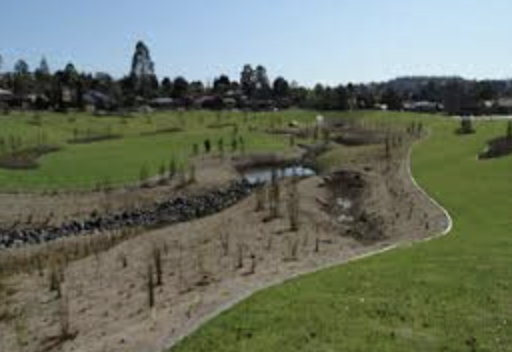
(The East Creek detention basin in Toowoomba. Image: Toowoomba Regional Council)
The Toowoomba Regional Council website states that the East Creek - Ballin Drive and Garnet Lehmann detention basins play a key role in reducing major flood peaks downstream, including the inner city and where East Creek meets West Creek. Together, the basins at Ballin Drive and Garnet Lehmann provide important benefits:
- lower flood depths by about 500mm in the CBD during a one-in-100-year event
- reduce peak flow rates by around 40% at James Street and 30% at Ruthven Street
- remove at least 15 properties from the one-in-100-year flood zone
- improve safety for pedestrians and road users
- cut costs for road culvert upgrades and channel works
- reduce repair and maintenance costs for roads, footpaths, and community assets
- better control of stormwater and erosion.
We can say with confidence that the detention basins in the upper catchments of the Richmond River will be a great deal larger than those in Toowoomba.
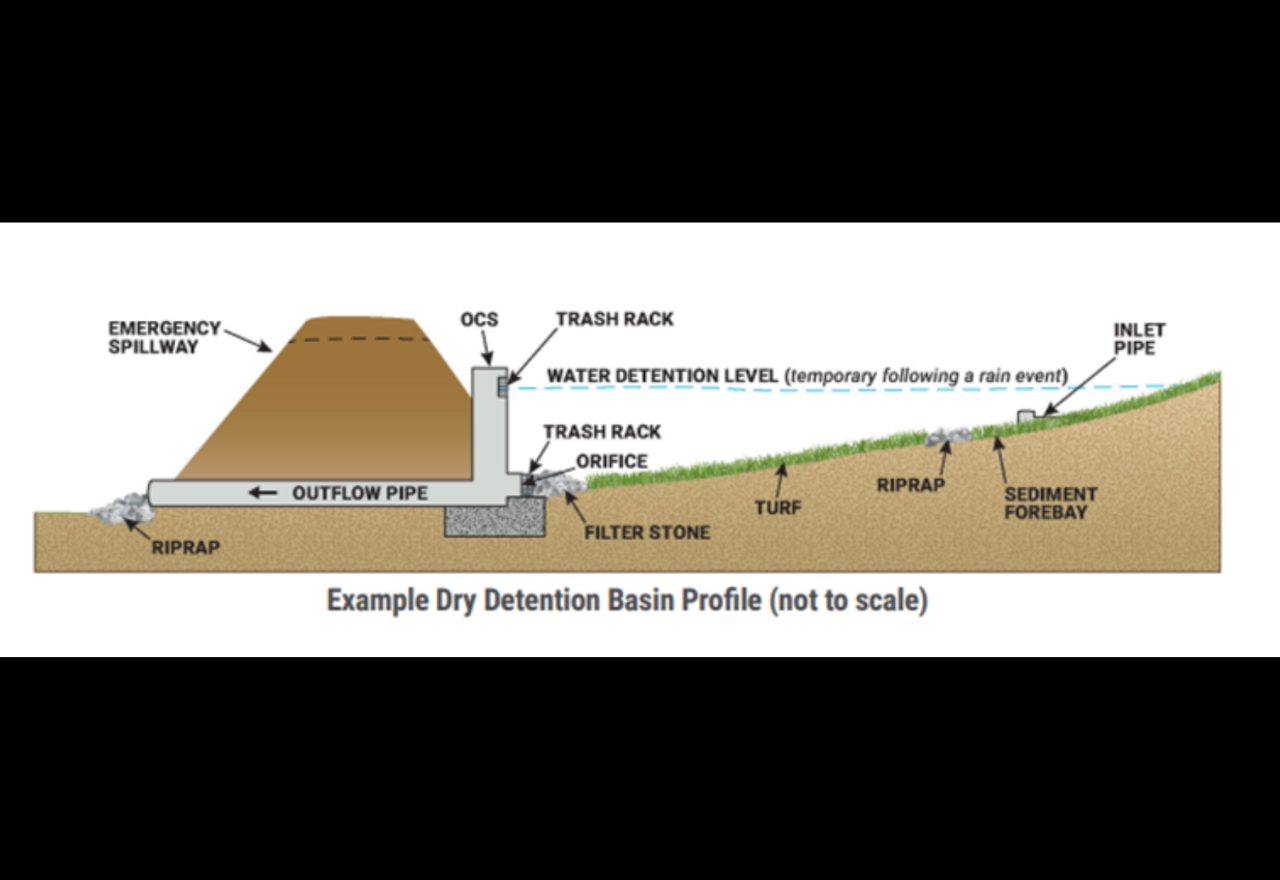
The best example of a dry detention basin comes from Gwinnett County Government in Georgia, USA.
They say the Key Features of a Dry Detention Basin, include:
- The dam, or embankment, impounds water to reduce downstream flooding.
- A sediment forebay slows incoming stormwater runoff and allows sediment to settle out.
- The outlet control structure (OCS) contains a low flow opening, or orifice, that controls the flow of water out of the basin. In the event of heavy rain, the OCS also includes a high-flow opening that allows water to bypass the basin and prevent the embankment from overtopping.
- The bottom of the dry detention basin is gradually sloped towards the outlet to allow water to drain out of the basin and prevent standing water. Vegetation (typically turf grass) helps provide some water quality benefit, stabilizes soil in the dry detention basin, improves aesthetics, and can also provide recreation opportunities.
- Riprap is installed at the forebay to slow down runoff and filter sediment, debris, and other solids from runoff.
- Filter stone is typically installed in front of an OCS to filter sediment, debris, and other solids from runoff.
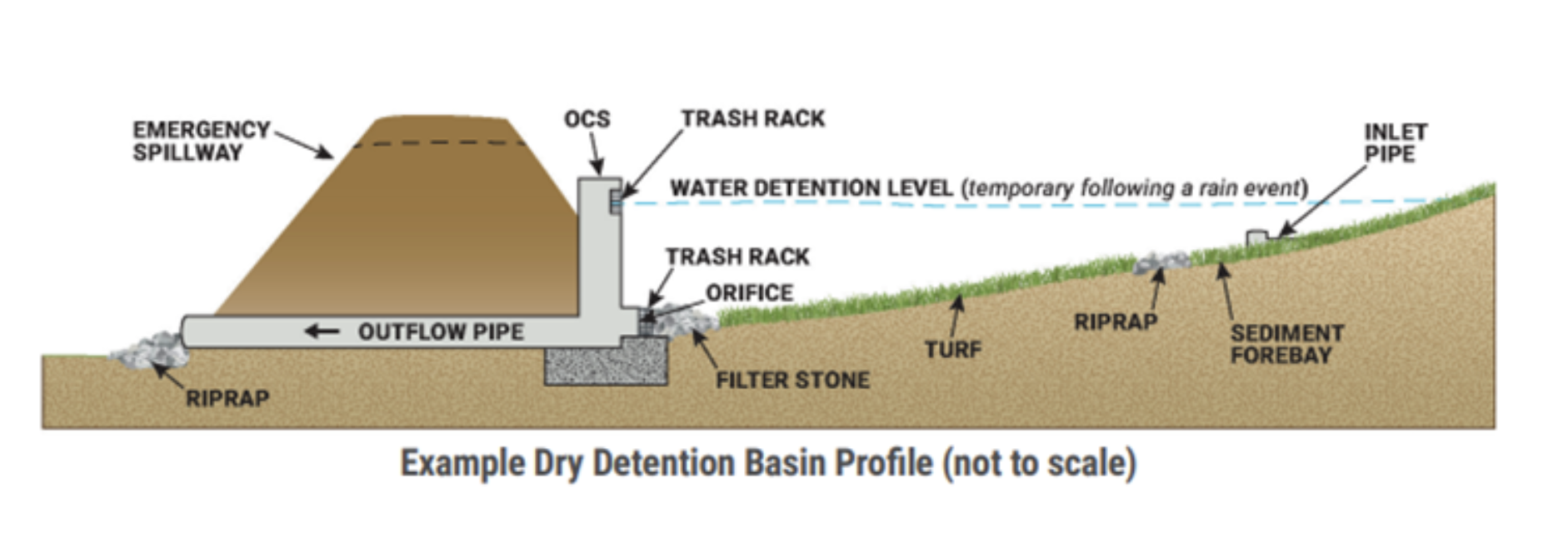
(An image of a dry detention basin from the Gwinnett County Government.)
For a video representation, click here to go to their website. There is also a list of maintenance suggestions for a detention basin.
This was supported by the brief comments made by Queensland's Department of Local Government, Water and Volunteers that detention basins usually use natural land contours, but may include man‑made embankments if needed.
It is likely that our detention basins will involve mechanical gates to release larger volumes of water, they said many basins use passive overflow structures with walls and outlets that are commonly soil, rock, concrete, or reinforced culverts. This naturally, releases water gradually.
Detention basins can be interconnected, so for the Richmond River Catchment, they could be part of a coordinated catchment system using sensors and modelling.
When it comes to preparing a site for a detention basin, the site is surveyed and shaped; some vegetation is cleared, but key areas may be retained. Grass, shrubs and riparian plants are often kept to stabilise soil.
In a heavy rainfall event, the advice is that short‑term inundation usually does not harm flood‑tolerant plants. Vegetation does play a role in a detention basin, slowing the flow, reducing erosion, and improving water quality.
As for the flow of water released into the catchment to minimise flooding in the low-lying urban town centres, like Lismore, and further downstream, like Coraki, this can be determined by CSIRO modelling from the history floods, in this case 2008, 2017 and 2022.
The above tells us that while detention basins have been used successfully in other local government areas in NSW and Queensland, they are not on the scale that may be needed to effectively reduce a major flood by 1-2 metres. As Jai Vaze has said previously, if it can be reduced at all.
We patiently await the release of the modelling results on 30 June, 2026.
Only $4 per month.....
Stand by us and support local journalism and local jobs by unlocking this article and becoming a Premium Content subscriber of the Lismore App for only $4 a month. You will gain unlimited access to all of our membership content.