New report indicates resilience in NRs economy despite government spending

01 December 2025, 7:00 PM
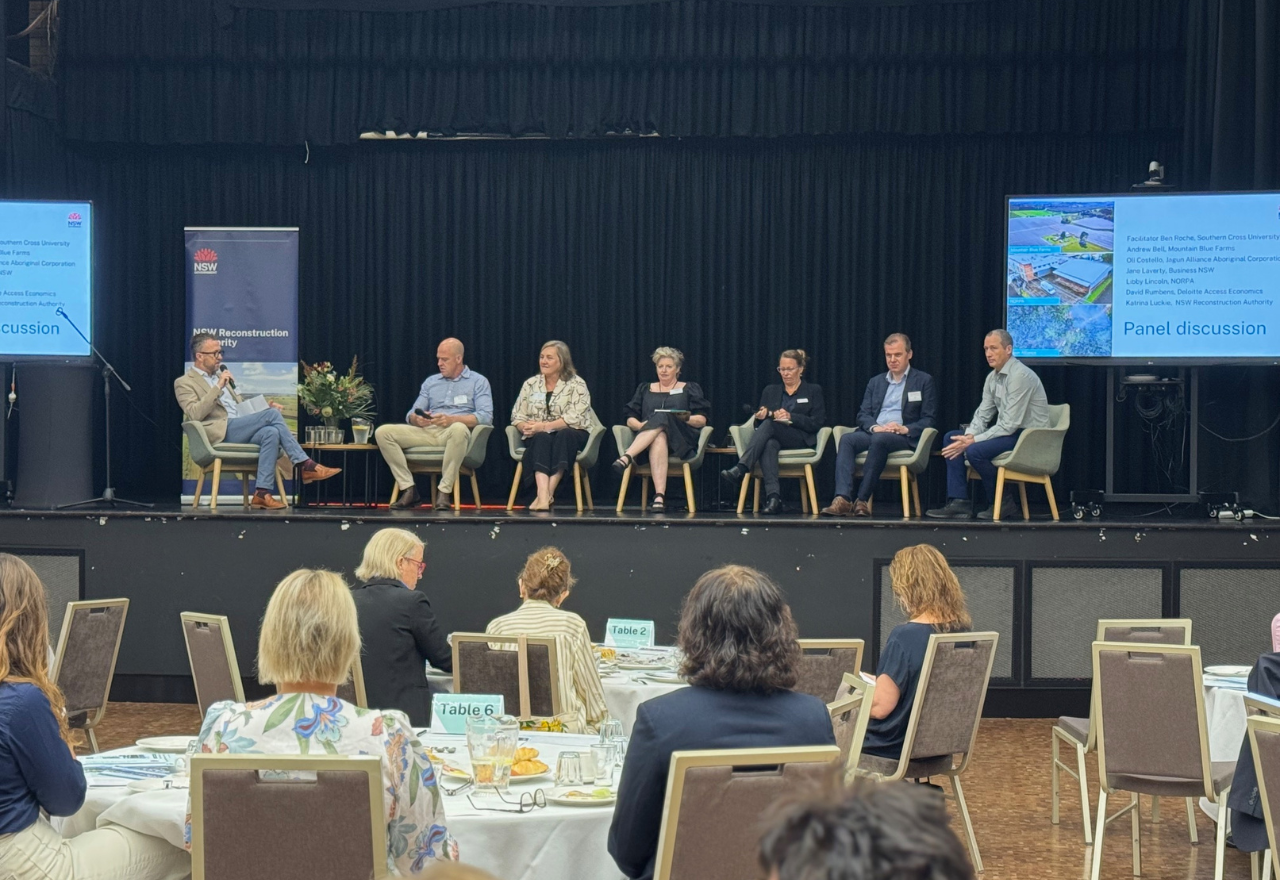 A panel session featuring key Norther Rivers industry leaders at yesterday's Northern Rivers Economic Profile and Natural Hazard Impact Report release at the Lismore Workers Club
The NSW Reconstruction Authority (RA) yesterday released its landmark report revealing the scale of economic disruption experienced in Lismore and the Northern Rivers following three natural disasters over the past six years.
The Northern Rivers Economic Profile and Natural Hazard Impacts Report, created by Deloitte Access Economics, examines the cumulative impact of the 2019–20 bushfires, the 2022 floods and ex-Tropical Cyclone Alfred in 2025 on the region. The report does not look at any one city/town in isolation, so although Lismore was the hardest hit in the 2022 floods, the impact is on a regional level.
This landmark study is a first for regional Australia; it provides the most comprehensive assessment to date of how the disaster has affected the region’s people, infrastructure and future development. Insights from this report will directly inform the Northern Rivers Disaster Adaptation Plan, the first region-wide plan to reduce disaster risk.
A group of prominent businesspeople, Minister for Recovery Janelle Saffin and local Mayors attended a breakfast at the Lismore Workers Club, where the report was presented. They discovered that the Northern Rivers Gross Regional Product (GRP) – the value of all goods and services produced for the Northern Rivers – took a cumulative $4 billion hit from these disasters over the past six years.
The report also estimates that these disasters resulted in $6.9 billion of socio-economic costs, of which, $3.7 billion was associated with the 2022 floods.
The economic recovery varied following each disaster, with the 2022 floods taking eight months and ex-Tropical Cyclone Alfred taking one month.
The costs include economic losses to businesses, homeowners and public assets, as well as indirect economic impacts from lost productivity and supply chain disruption. Plus, the social costs to health and mental well-being. And finally, the money spent by all levels of government in emergency response, recovery and government support.
Encouragingly, despite these devastating economic impacts, the report found that the region’s GRP still grew by 17.9% in real terms since 2019, reaching $22.8 billion in 2024. This growth matches that of Regional NSW at 18% (for the same period), which has not experienced the same range of natural hazard disasters as the Northern Rivers.
David Rumbens, a Partner at Deloitte Access Economics, said government spending has certainly contributed to the Northern Rivers recovery and the region's GRP, but there are underlying economic strengths of its own.
"The region has many strengths across agriculture, forestry, tourism, healthcare, construction. Part of the government effort is supporting the region, so it's contributing to the region's growth, but the region has its own underlying strengths."
Key industries like agriculture and tourism were highly exposed to the impacts of natural hazards, while businesses identified the vulnerability of the region’s infrastructure—power, transport, and telecommunications— as a major concern. Other challenges include high insurance costs, housing shortages, labour stress, and the cumulative impact of disasters on business viability and wellbeing.
The report stated that insurance costs had risen 94% between 2021 and 2024.
Report findings will help identify priority risks, shape targeted risk reduction actions and support the development of long-term adaptation pathways to deliver the greatest social and economic benefit for the region.
As this next stage of adaptation and recovery planning begins, the RA is committed to working closely with local communities. Their insights and experience will be central to shaping an adaptation plan that reflects local priorities, shapes targeted risk reduction actions, strengthens resilience, and supports long-term regional renewal.
To find out more about the Northern Rivers Adaptation Plan, go to https://www.nsw.gov.au/departments-and-agencies/nsw-reconstruction-authority/our-work/disaster-adaptation-plans/northern-rivers-dap.
NSW Reconstruction Authority A/Head, Adaptation, Mitigation & Reconstruction Kristie Clarke said, “We all know that economies take a hit every time disaster strikes. Now, for the first time, we have measured the true size of the hit to the Northern Rivers economy across three disasters.
“We need to collaborate, innovate and work together, across industries and businesses, to champion resilience, invest in adaptation and shape an economically strong and disaster-resilient Northern Rivers.
“Encouragingly, this report highlights that many businesses in the Northern Rivers are already taking the necessary steps towards that goal.”