Lismore Council dumps its waste in its own backyard once again

Simon Mumford
05 December 2025, 7:00 PM
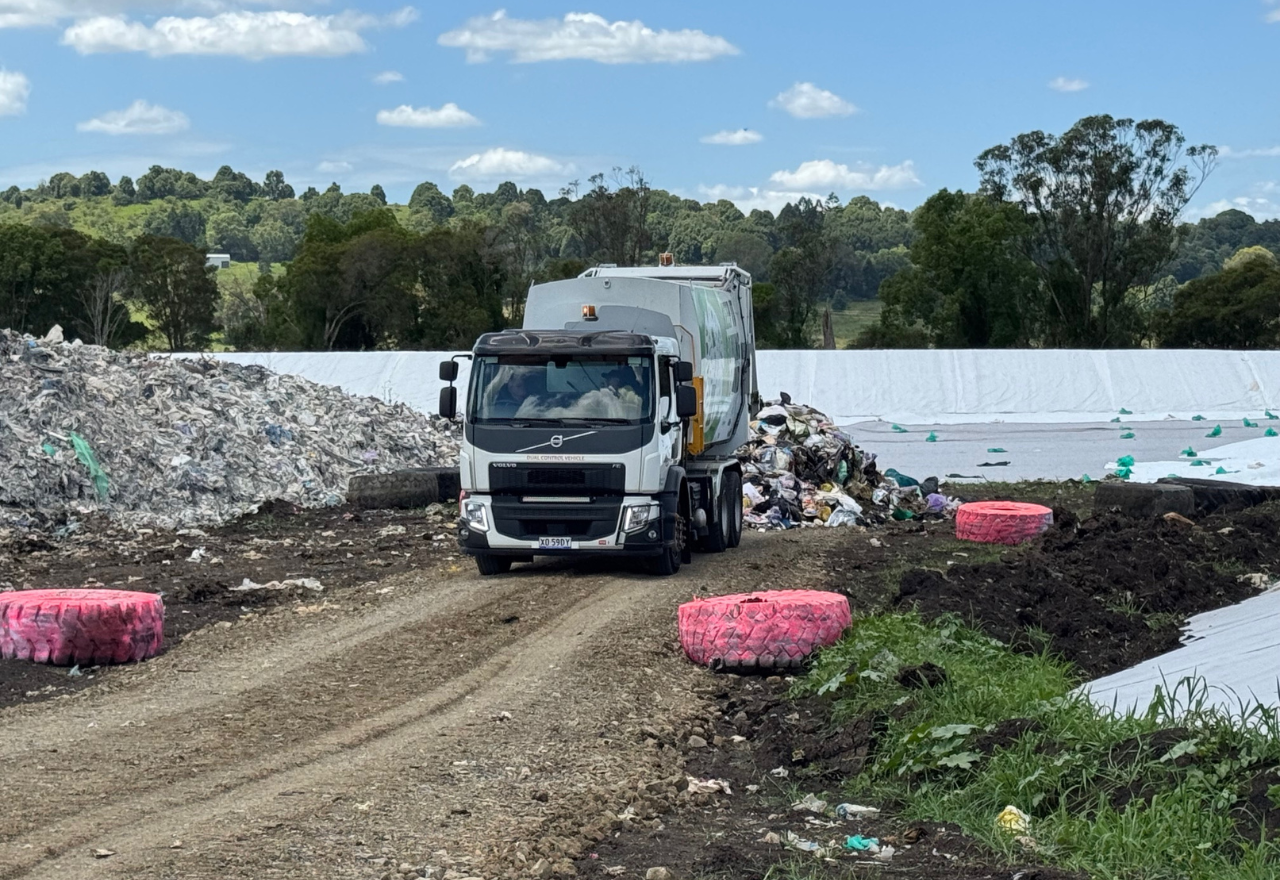
After nearly four years of trucking our waste to Queensland, Cell 2B at the Lismore Recycling and Recovery Centre (LRRC) began to officially receive red bin waste on Wednesday, six months ahead of schedule.
You may remember the time-lapse video from the February 28 flood that destroyed the lining and caused leachate issues at the landfill site.
Originally established in the 1960s, the landfill at the LRRC on Wyrallah Road has served as the central disposal facility for Lismore’s residual waste for decades.
The federal and state governments provided $15.6 million under the jointly funded Disaster Recovery Funding Arrangements (DRFA). Works were managed by Lismore City Council’s Flood Restoration Portfolio, with a further $3.6 million provided through the Infrastructure Betterment Fund, delivered under the DRFA to support more resilient reconstruction.
While not usually an exciting topic, both Lismore Mayor Steve Krieg and Minister for Recovery Janelle Saffin had smiles on their faces when the ribbon was cut. That is another Flood Restoration Project that can be ticked off the long list.
The smiles for the mayor and council staff were larger because of the $2 million in transport costs that council will save by not having to travel to Ipswich every week, dumping 17,000 tons of waste over 12 months. Plus, the waste levies will stay in NSW and not be paid to the Queensland government.
"We've got a proud tradition of looking after, looking after our own community. So it's really good to have this open before Christmas. It wasn't due to be open for another six months. It's another major project that's been delivered after the 2022 flood, and it's something that's going to build on, keeping our jobs local, keeping our money local, and our levies local."
Minister Saffin explained that the reason for the delay in the project being completed was due to the continuous rainfall Lismore has received for the last two years, and drying the liner was a critical component where a dry spell was needed for the water to recede.
"It just takes time to do it. It's a big liner. It's a huge one. But equally, there's been some favourable weather recently, where it was able to come in a lot quicker than it was originally due. So it's a great Christmas present to have it done.
"It is Disaster Relief Funding arrangement money, I think it was around $15 million, with $3.6 million for betterment. And we love betterment, where we can do it.
Nick Baker is the Deputy Director Waste Program for Lismore City Council. Nick has led the restoration work and explained how Cell 2B has been built back better.
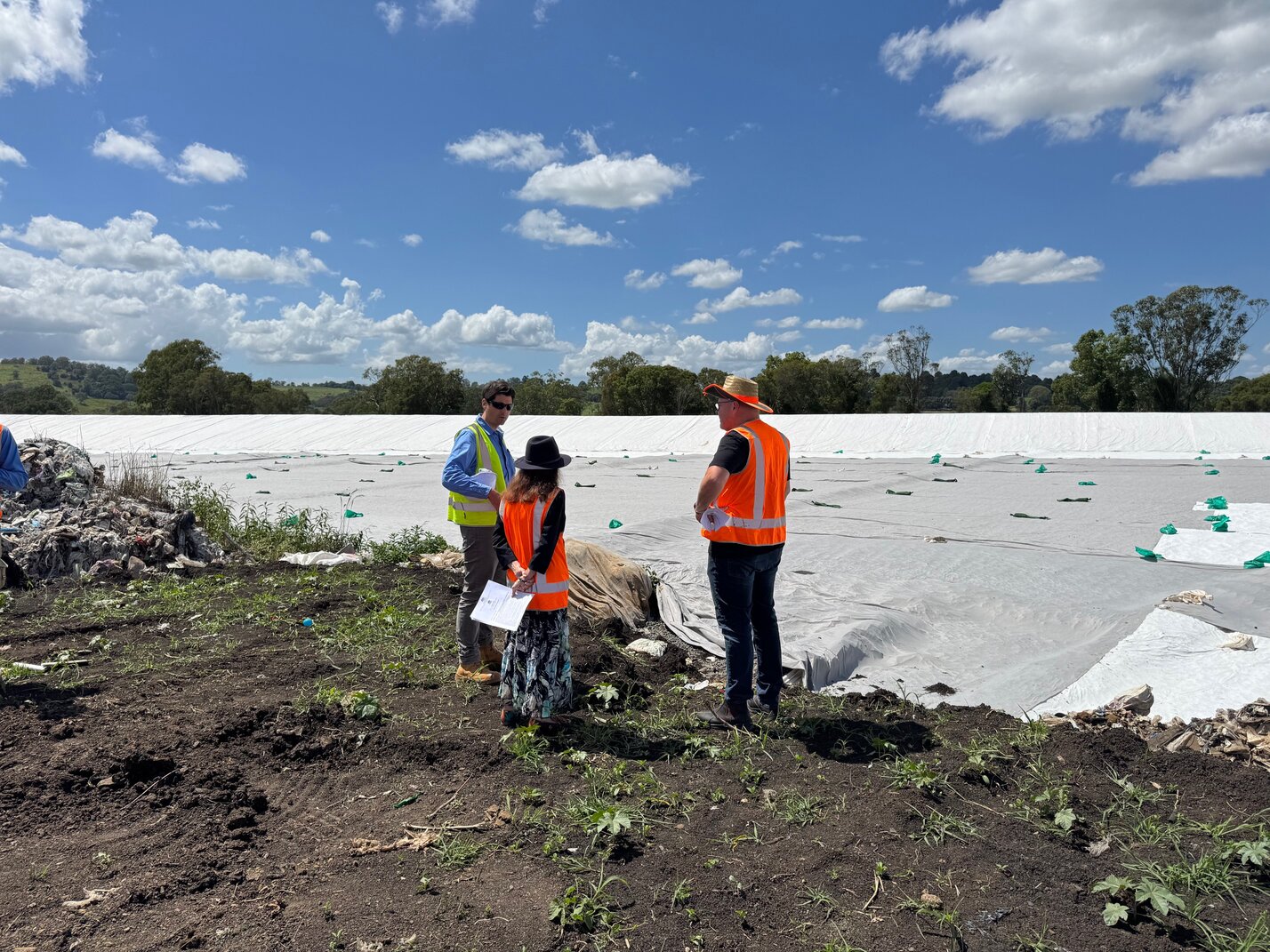
(Nick Baker talks to Janelle Saffin, Minister for Recovery, and Steve Krieg, Lismore Mayor about Cell 2B)
"We exhumed circa 10,000 cube of waste, probably four or five Olympic swimming pools, just to be able to undertake the repair work. So a really challenging, complex job.
"It's a geosynthetic clay liner and HDPE liner, so a composite lining system, effectively clay and plastic that allows us to safely collect the leachate and then ensure that we can collect that leachate, treat it, and then discharge it, and it doesn't make its way to the environment.
As we saw in the 2022 video, the liner peeled back, allowing leachate to enter the environment. What has been done to ensure that does not happen again?
"As part of our restoration work, we installed what we call an anchor trench, so if there was to be a future event, that lining is actually secured from future floods where it wasn't previously."
Cell 2B has a 7 to 10 year life, so in that time, Council staff are investigating alternative locations for future land filling, one of which is a regional site solution that would last 50 years, namely Blakebrook Quarry, which the Lismore App has reported on in previous waste stories. Another site was considered at the current location; however, due to the threat of a major flood, it was deemed inappropriate.
As regular Lismore App readers would know, a regional solution needs a commitment from other local councils at a price that makes sense for their budgets.
When asked what the $2 million is savings will be spent on, Director of Waste and Water Mick Potter said there are a lot of compliance projects that need to completed on the existing site.
"We've got Cell 1 and 2 that we need to cap and close. We're no longer filling these cells, so we're in investigation works now to close that landfill and just have this one here.
"We've got pump infrastructure. So, Nick mentioned leachate. It's generated. It's a liquid generated from the waste that needs to be treated. We've got pumping systems going in and looking at a treatment facility for the leachate.
"There's plenty of capital works projects that are compliance related on this site, and for our future studies into a regional or a new landfilling cell."
Capping an old landfill cell
Council is investigating how to best cap Cell 1, with Cell 2 to be done at a later date. Capping is to stop leachate from entering the environment. That can be done through phytocapping, a plant-based technique that uses the root system to draw the rainfall back out of the cap before it makes its way into the waste mass or a geosynthetic or engineering liner.
"What we're working through at the moment is what gives us the best seal of that landfill, which ultimately reduces how much leachate we generate and then have to treat and reduce environmental risk. So we're working through that at the moment, and we'll have a solution within the next six months," Nick said.
Matt Potter added, "Due to the high rainfall in our area, that may not be the best option, the phytocapping that we've done previously. We're looking at cost-effective solutions, because, again, it's a lot of money to close a cell.
Only $4 per month.....
Stand by us and support local journalism and local jobs by unlocking this article and becoming a Premium Content subscriber of the Lismore App for only $4 a month. You will gain unlimited access to all of our membership content.