CPI rose 3.8% in the year to January 2026

25 February 2026, 4:03 AM
Another case for raising interest rates a second time in 2026 occurred today when the Consumer Price Index (CPI) rose 3.8 per cent in the 12 months to January 2026, according to the latest data from the Australian Bureau of Statistics (ABS).
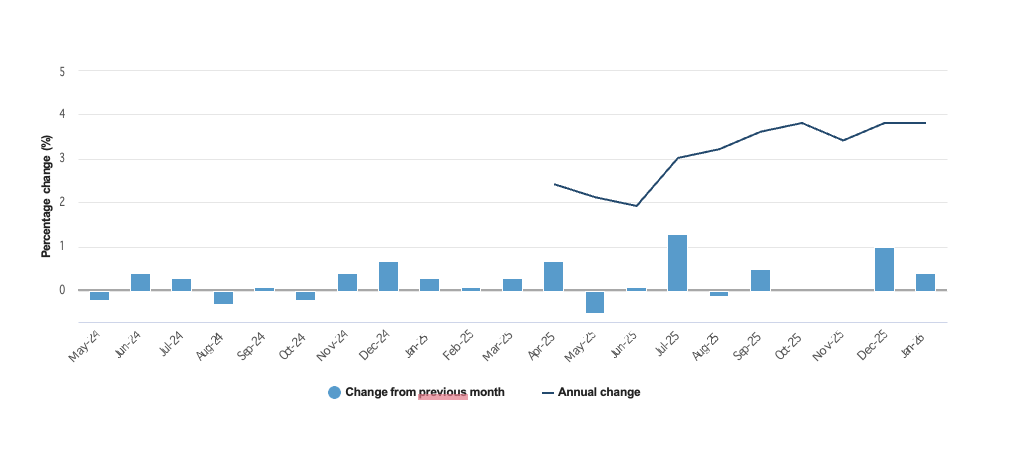
Michelle Marquardt, ABS head of prices statistics, said: ‘The 3.8 per cent annual CPI inflation to January was unchanged from December.’
The largest contributor (/statistics/economy /price-indexes-and-inflation/consumer-price-index-australia/jan-2026#cpi-groups) to annual inflation in January was Housing, up 6.8 per cent. This was followed by Food and non-alcoholic beverages, up 3.1 per cent, and Recreation and culture, which rose 3.7 per cent.
All groups CPI, Australia, monthly and annual movement (%)
When prices for some items change significantly, measures of underlying inflation like the Trimmed mean (https://www.abs.gov.au/statistics/economy/price-indexes-and-
inflation/consumer-price-index-australia/latest-release#overview) can give more insights into how inflation is trending.
‘Trimmed mean inflation was 3.4 per cent in the 12 months to January 2026, up from 3.3 per cent in the 12 months toDecember 2025,’ Ms Marquardt said.
Annual Housing inflation was 6.8 per cent to January, up from 5.5 per cent to December. This reflects cost rises inElectricity, New dwellings and Rents.
Electricity costs rose 32.2 per cent in the 12 months to January, up from 21.5 per cent to December.
The increase in electricity costs over the year is mostly related to households using up both the extended Commonwealth Energy BillRelief Fund (EBRF) and various State Government rebates. The higher increase in the year to January compared toDecember reflects the cessation of the EBRF rebates.
Excluding the impact of the Commonwealth and State Government electricity rebates over the previous year, electricity prices rose 4.5 per cent in the 12 months to January. This reflects annual price reviews by energy retailers inJuly 2025.
Electricity Index, Australia
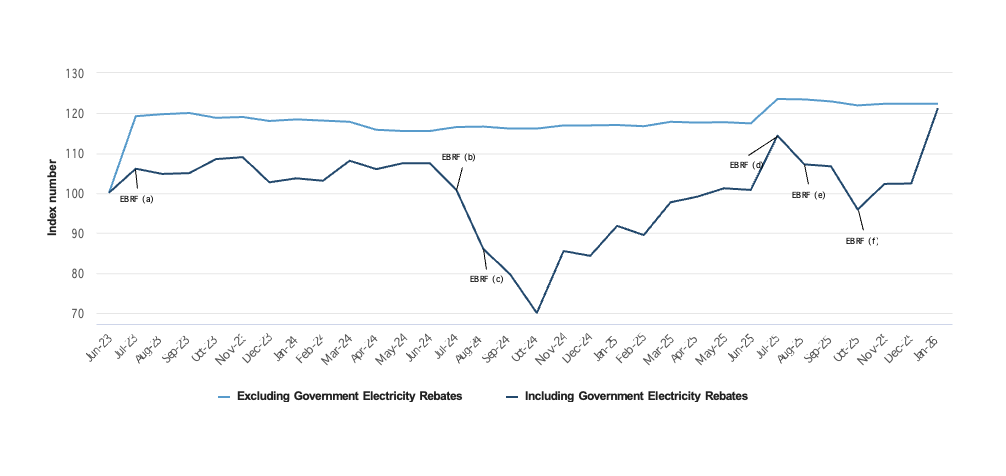
June 2023, index = 100
Introduction of the 2023-24 Commonwealth Energy Bill Relief Fund (EBRF) rebates
Introduction of the first instalment of the 2024-25 EBRF rebates for all households in QLD and WA, and State rebates in QLD, WAand TAS
Introduction of the first instalment of the 2024-25 EBRF rebates for all households in NSW, VIC, SA, TAS, NT and ACT
Introduction of the first instalment of the EBRF 2025 extension rebates for all households in VIC, QLD, SA,
TAS and NT
Introduction of the first instalment of the EBRF 2025 extension rebates for all households in NSW and ACT
Introduction of the first instalment of the EBRF 2025 extension rebates for all households in WA
Annual inflation for Food and non-alcoholic beverages was 3.1 per cent to January, down from 3.4 per cent in the 12 months to December.
Food inflation continues to be elevated due to higher prices for Meals out and takeaway, up 3.9 per cent in the year to January, driven by rises in wages and ingredient costs.
Annual inflation for Recreation and culture was 3.7 per cent to January, down from a 4.4 per cent rise to December.
Domestic holiday travel and accommodation prices rose 5.6 per cent in the 12 months to January, down from a 9.6 per cent rise in the 12 months to December.