2025 4th hottest on record: A wet start to 2026

Simon Mumford
06 January 2026, 6:54 PM
As towns and cities across Australia swelter over the next few days, as the mercury reaches the mid-40s, the Bureau of Meteorology has released its Climate Summary information for 2025.
Climatology Specialist Nadine D’Argent said, according to the primary summary, Australia experienced its fourth-warmest year on record in 2025, with temperatures 1.23 °C above the 1961–1990 average.
“This follows Australia’s second-warmest year in 2024,” Ms D’Argent said.
“South Australia and Western Australia both recorded their third-warmest years.
“Between January and March, and between October and December, large parts of Australia experienced heatwave conditions, reaching extreme severity at times.
“Australia’s warmest year was in 2019, when the national annual average temperature was 1.51 °C above average.”
State of the Climate 2024 found that Australia’s climate has warmed by an average of 1.51 ± 0.23 °C since national records began in 1910.
The warming in Australia is consistent with global trends, with the degree of warming similar to the overall average across the world’s land areas.
Rainfall:
“Last year, the national average annual rainfall was 7.8% above the 1961–1990 average at 502.2 mm,” Ms D’Argent said.
“Rainfall was below average for most of Tasmania, Victoria and South Australia, southern and inland areas of New South Wales and large parts of Western Australia.
“Rainfall was above average for much of Queensland, northern and eastern parts of the Northern Territory, coastal areas of New South Wales and northern and some southern areas of Western Australia.
“Queensland had its wettest year since 2011 with rainfall 31% above average, while Tasmania had its driest year since 2017 and South Australia its driest since 2019.”
The Next Three Months:
As locals know, February and March are the wettest months in Lismore and the Northern Rivers. That trend looks set to continue with the BoM's long-term weather forecasts.
The median rainfall for January to March is 510.6mm, and the chance of that being exceeded is 63%, while the chance of an unusually wet three months, that is greater than 689mm, is 35%. By comparison, the chance of an unusually dry period is 11%.

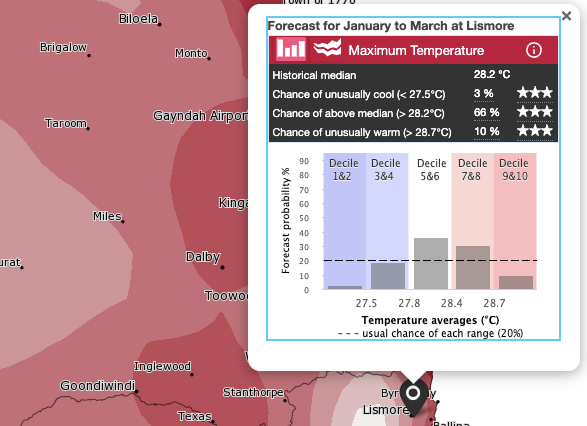
As for the expected temperatures, it should be slightly warmer than the historical median of 28.2 degrees Celsius. The chance of it being warmer is 66%. The good news here is that the chance of an unusually warm, above 28.7 degrees, is only 10%.
The BoM's full Annual Climate Statement for 2025 will be released in early February.
Thanks for reading...
Stand by us and support local journalism and local jobs by unlocking this article and becoming a Premium Content subscriber of the Lismore App for only $4 a month. You will gain unlimited access to all of our membership content.